
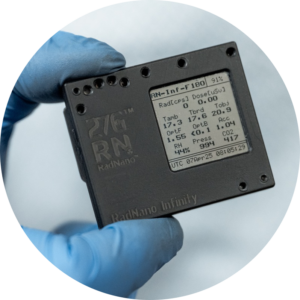
RadNano Infinity is a tiny portable active electronic dosimeter, optimized for small size and power consumption. These instruments were designed to track the radiation exposure of astronauts during crewed space missions and to collect scientific data, equipped with further environmental sensors (temperature, humidity, pressure, inertial measurement unit, CO2 and air quality, light intensity sensors and magnetometer) to completely cover the environmental condition monitoring of the crew or mission experiments. The energy efficient semiconductor technologies of 27G made it possible to design a lightweight portable handheld device that can operate for months using its integrated rechargeable battery without any external charge. The actual status of the device and the measured environmental parameters are visible for the users on a small LCD display, the recorded data is accessible for further technical and scientific analyses. Alarms could be also activated to help the users to avoid potentially dangerous situations.
Axiom-4 (Ax-4) crewed spaceflight (2025), Dragon Spacecraft, International Space Station
https://www.nasa.gov/mission/station/research-explorer/investigation/?#id=9339
https://www.spacex.com/launches/ax4