
27G-Technology is pleased to announce the publication of a new scientific study presenting acceleration measurements collected during Axiom Mission 4 (Ax-4). The article has been published in the Journal of Space Safety Engineering.
The study analyses data recorded by accelerometers integrated into the RadNano Infinity Astronaut Dosimeters developed by 27G-Technology. During the Ax-4 mission, ten of these compact instruments accompanied astronauts and experiments of the HUNOR Hungarian Astronaut Program, collecting time-resolved measurements during launch, orbital operations aboard the International Space Station and return to Earth.
Measuring the acceleration environment from launch to return
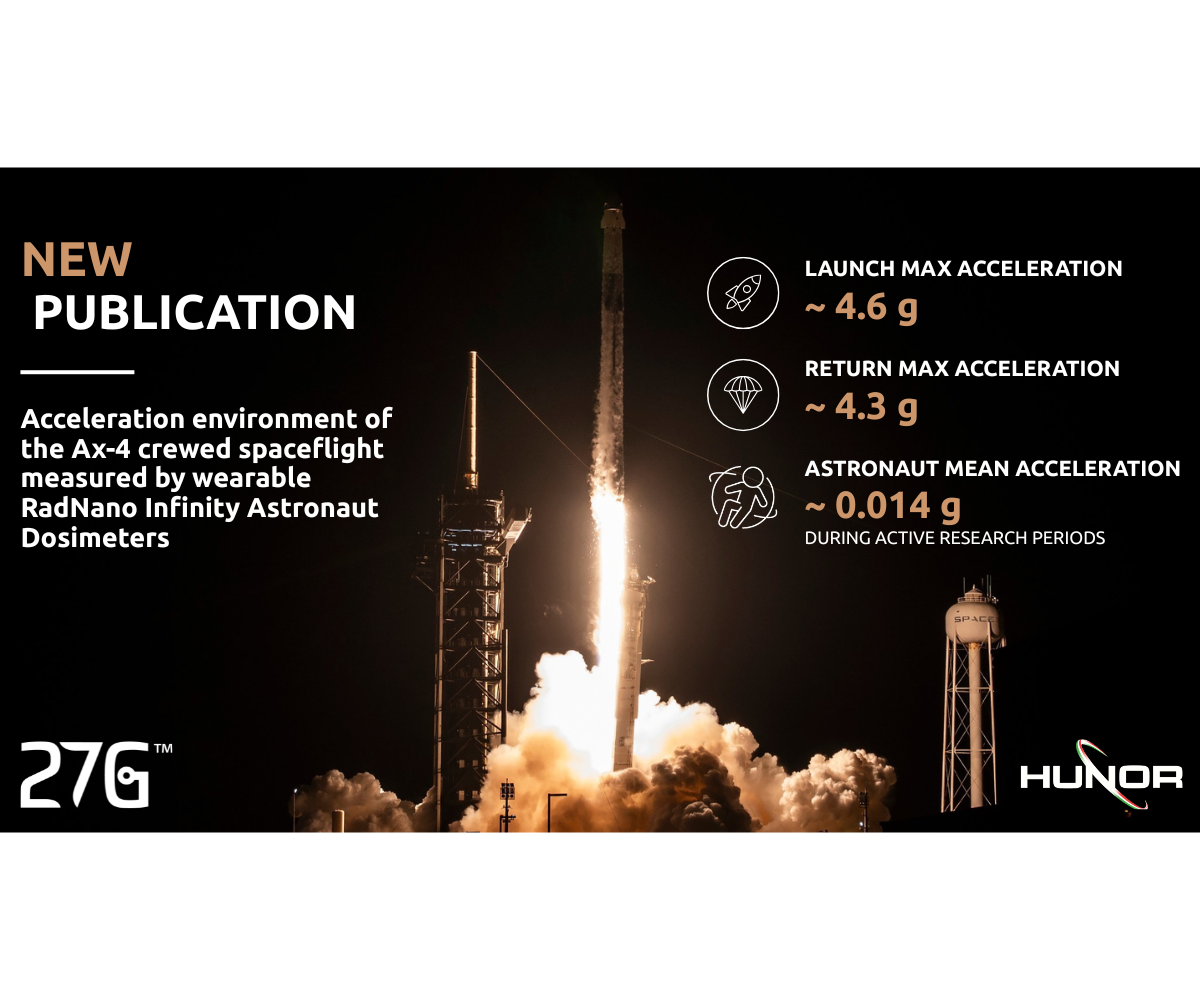
The instruments recorded a peak acceleration of nearly 4.6 g during the launch of the SpaceX Dragon spacecraft. During the return to Earth, the highest measured value was approximately 4.3 g.
In addition to these major mission events, the study examined the acceleration environment experienced during everyday research activities aboard the International Space Station. During the astronauts’ active research periods, the body-worn instruments recorded a mean acceleration magnitude of 0.0139 g, equivalent to approximately 1.4% of standard gravity.
This value is several orders of magnitude higher than the nominal microgravity level of the ISS. It does not indicate a change in the underlying microgravity conditions; instead, it primarily reflects local accelerations generated by astronaut movement and routine on-orbit activities.
Direct measurements from compact, wearable instruments
Acceleration data from crewed space missions are often associated with vehicle-level telemetry. The RANDAM measurements complement these data by providing direct observations from miniaturised instruments deployed with astronauts and experimental payloads.
The results demonstrate that compact, wearable devices can characterise not only the major acceleration loads associated with launch and return, but also the considerably smaller motion-related accelerations occurring during orbital operations.
Such measurements can contribute to a better understanding of the operational environment experienced by astronauts, scientific payloads and onboard instrumentation. They may also support the design, qualification and assessment of wearable technologies and compact scientific instruments intended for future crewed space missions.
Expanding the capabilities of space dosimetry
RadNano Infinity was developed primarily as a miniaturised active dosimeter for monitoring ionising radiation exposure. Its integrated environmental and motion sensors, however, enable the same instrument platform to provide a broader picture of the conditions encountered throughout a space mission.
The acceleration study forms part of the wider RANDAM research programme, which investigates radiation exposure and environmental conditions during the complete Ax-4 mission using a distributed network of RadNano Infinity instruments.
Further RANDAM publications provide detailed results on the radiation exposure of astronauts and payloads, as well as the comprehensive environmental dataset collected during the mission.
Read the full article in the Journal of Space Safety Engineering: https://www.sciencedirect.com/science/article/pii/S2468896726001047
Background picture credit: Axiom Space
Read more:
https://www.nasa.gov/mission/station/research-explorer/investigation/?#id=9339
https://27g.space/wp-content/uploads/RadNano_Infinity_Datasheet.pdf
https://www.spacex.com/launches/ax4
https://hunor.gov.hu/index.php/randam-english/


