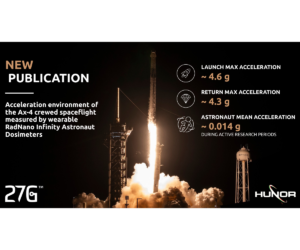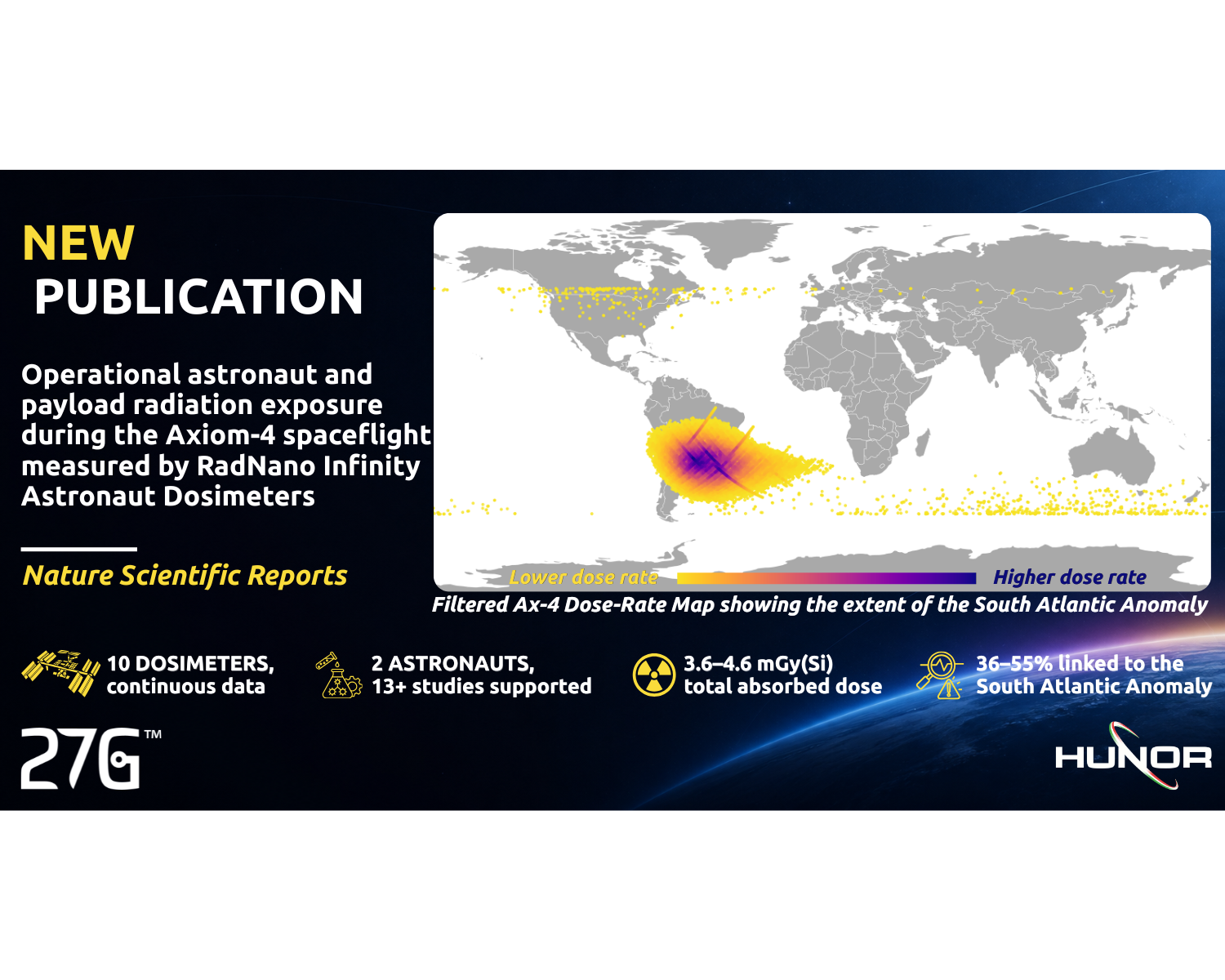
27G-Technology is pleased to announce a new peer-reviewed paper published in Nature Scientific Reports, presenting continuous, distributed radiation measurements from the complete Axiom-4 crewed spaceflight. Ten compact RadNano Infinity Astronaut Dosimeters monitored the radiation environment from launch to splashdown, providing second-by-second data throughout the entire space mission.
The study demonstrates how miniaturised and energy-efficient active dosimeters can support astronaut exposure assessment, payload monitoring and high-resolution mapping of the radiation environment.
The results were published in Nature Portfolio’s Scientific Reports, the second most-cited journal in the world in 2025.
Ten compact dosimeters covering an entire spaceflight
The Axiom-4 mission launched on 25 June 2025 and returned to Earth on 15 July after more than 20 days in space and approximately 320 orbits around the planet. The mission provided an opportunity to test distributed dosimetry during all major phases of a modern crewed spaceflight: launch, transfer aboard the Dragon spacecraft, docking, operations on the International Space Station, undocking and return to Earth.
27G’s ten independently operating RadNano Infinity instruments accompanied the astronauts and scientific experiments throughout the mission. Two dosimeters were regularly worn by astronauts during their work aboard the ISS. Other units monitored biological, medical, material-science and technology experiments of the HUNOR Astronaut Program, while selected instruments remained at reference locations inside the Destiny and Columbus modules or aboard the Dragon spacecraft. This distributed arrangement made it possible to compare radiation exposure at different locations instead of relying on measurements from a single fixed monitoring point.
Designed for efficient and flexible operation
Each RadNano Infinity instrument measures only 42 × 50 × 13.3 mm and has a total mass of approximately 55 grams. This compact size allows the dosimeter to be carried by an astronaut, attached to clothing using Velcro, secured with a carabiner or positioned directly beside a scientific payload without significantly affecting the experiment or crew operations.
Energy efficiency was one of the most important design requirements. The instruments were developed for more than two months of continuous operation using their internal rechargeable batteries, without external power, intervention or recharging during the mission. This capability enabled uninterrupted monitoring from launch to splashdown while maintaining a one-second radiation measurement resolution.
The instruments used various RadNano models to achieve detailed radiation exposure measurement results. In addition to radiation measurements, the devices can monitor environmental parameters including temperature, humidity, air pressure, air quality, light intensity and magnetic-field conditions. Their compact, autonomous and vacuum-capable design supports a wide range of potential applications—from personal astronaut dosimetry and payload monitoring to distributed spacecraft instrumentation and future extravehicular measurement concepts.
Key results from the Axiom-4 mission
The continuous measurements revealed several important features of the radiation environment:
- The dosimeters measured 3.6–4.6 mGy absorbed mission dose in silicon.
- Approximately 91.5% of the measured absorbed dose accumulated during the ISS habitation phase. The outbound and return transfer phases together contributed around 8.5% of the total mission dose.
- Representative measurement locations in different ISS modules showed dose differences of approximately 23–28%, highlighting the influence of local shielding, spacecraft structure and instrument placement.
- Passages through the South Atlantic Anomaly accounted for an average of approximately 44% of the total measured absorbed dose. Depending on instrument location and shielding, the contribution ranged from around 36% to 55%.
- The highest short-term dose-rate peaks were recorded during South Atlantic Anomaly passages, with individual instruments measuring maximum values between approximately 9 and 19.5 μGy/min.
- Literature-based radiation quality factors indicated estimated mission dose equivalents of approximately 13.7–15.6 mSv, relevant for exposure analyses of astronauts and biological and medical experiments.
A RadNano Infinity unit positioned near the permanently installed ISS radiation monitors also showed excellent agreement with the reference systems. Its temporal correlation with the ISS REM dosimeter exceeded 0.98, with near-identical absolute scaling, supporting the calibration and measurement approach applied during the mission.
A detailed radiation map from a relatively short mission
One of the most visually striking results of the study is the reconstructed global radiation dose-rate map. Despite the mission lasting only around 20 days, the combination of continuous operation, one-second measurements, precise timestamps and spacecraft orbital data provided sufficiently dense geographical coverage to resolve the radiation environment in considerable detail.
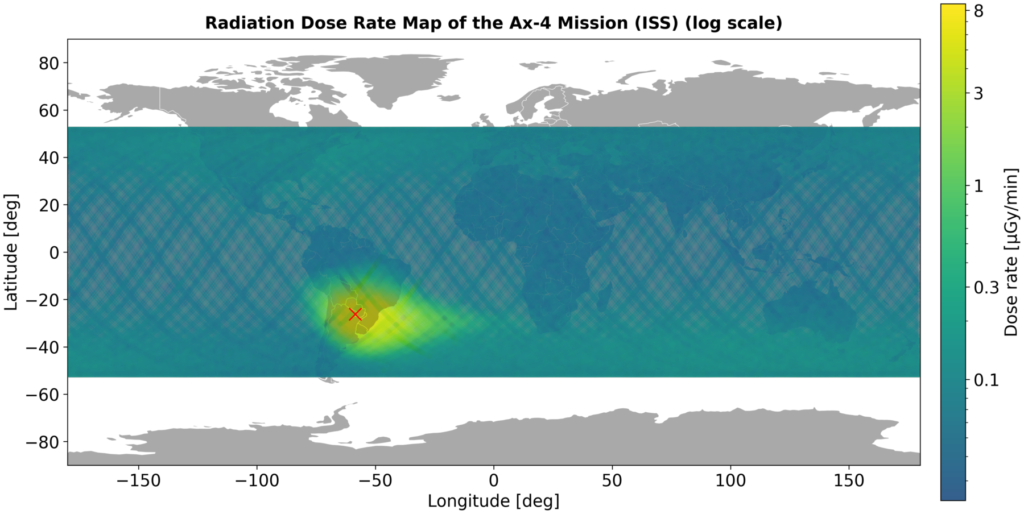
The resulting map clearly identifies the South Atlantic Anomaly as the dominant region of elevated dose rates. This region, where the inner Van Allen radiation belt approaches unusually close to Earth, was responsible for the short-duration radiation peaks recorded during the mission.
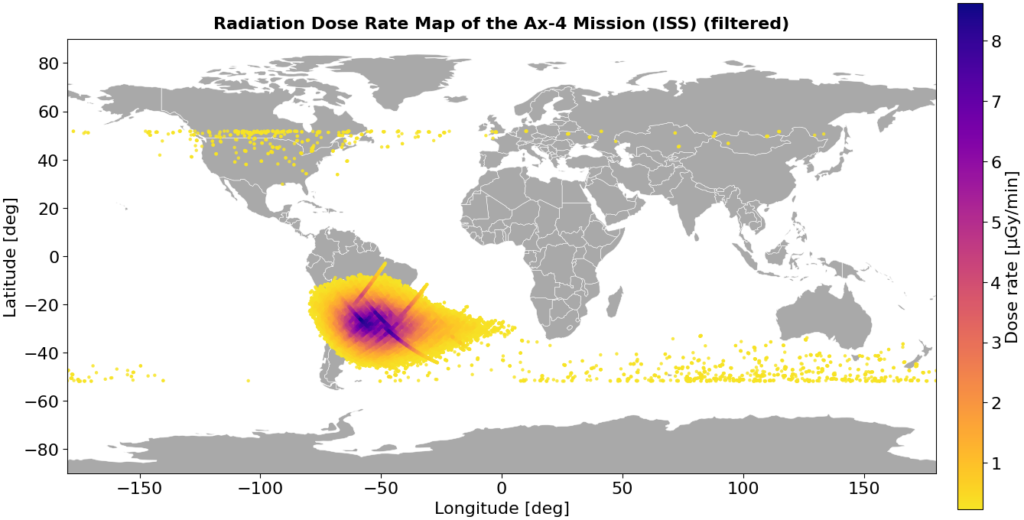
This achievement demonstrates an important advantage of high-temporal-resolution instrumentation: even during a relatively short spaceflight, continuous measurements can produce detailed spatial information that would be partially obscured by longer integration intervals or intermittent data acquisition.
Miniaturised dosimetry for future missions
The results demonstrate that meaningful operational radiation monitoring does not necessarily require large or power-intensive instruments. Compact, autonomous sensors can be distributed across a spacecraft, worn by crew members or placed beside sensitive scientific payloads, providing local information that complements permanently installed reference systems.
This combination of low power consumption, small size, autonomous operation and flexible deployment makes 27G’s RadNano technology particularly suitable for future human spaceflights, small spacecraft, scientific payloads and exploration missions where mass, volume and available electrical power are strictly limited.
The open-access publication is available in Scientific Reports:
https://www.nature.com/articles/s41598-026-65297-8
The research was supported by 27G-Technology Ltd., the Doctoral School of Engineering Sciences of the Hungarian University of Agriculture and Life Sciences and the HUNOR Astronaut Program. We are deeply grateful to the Ax-4 astronauts and to everyone at 27G-Technology, the HUNOR Astronaut Program, NASA, Axiom Space, ESA, MATE, HUN-REN ATOMKI, the University of Szeged and SpaceX who supported the Rad Nano Dosimeter Experiment.
Picture credit: Géczy & Seres (2026), Scientific Reports, 27G Scientific Visualisation.
Read more:
https://www.nature.com/articles/s41598-026-65297-8
https://doi.org/10.1038/s41598-026-65297-8
https://27g.space/wp-content/uploads/RadNano_Infinity_Datasheet.pdf
https://www.nasa.gov/mission/station/research-explorer/investigation/?#id=9339